



6 Towns & Mines (extracts)
6.1 Towns
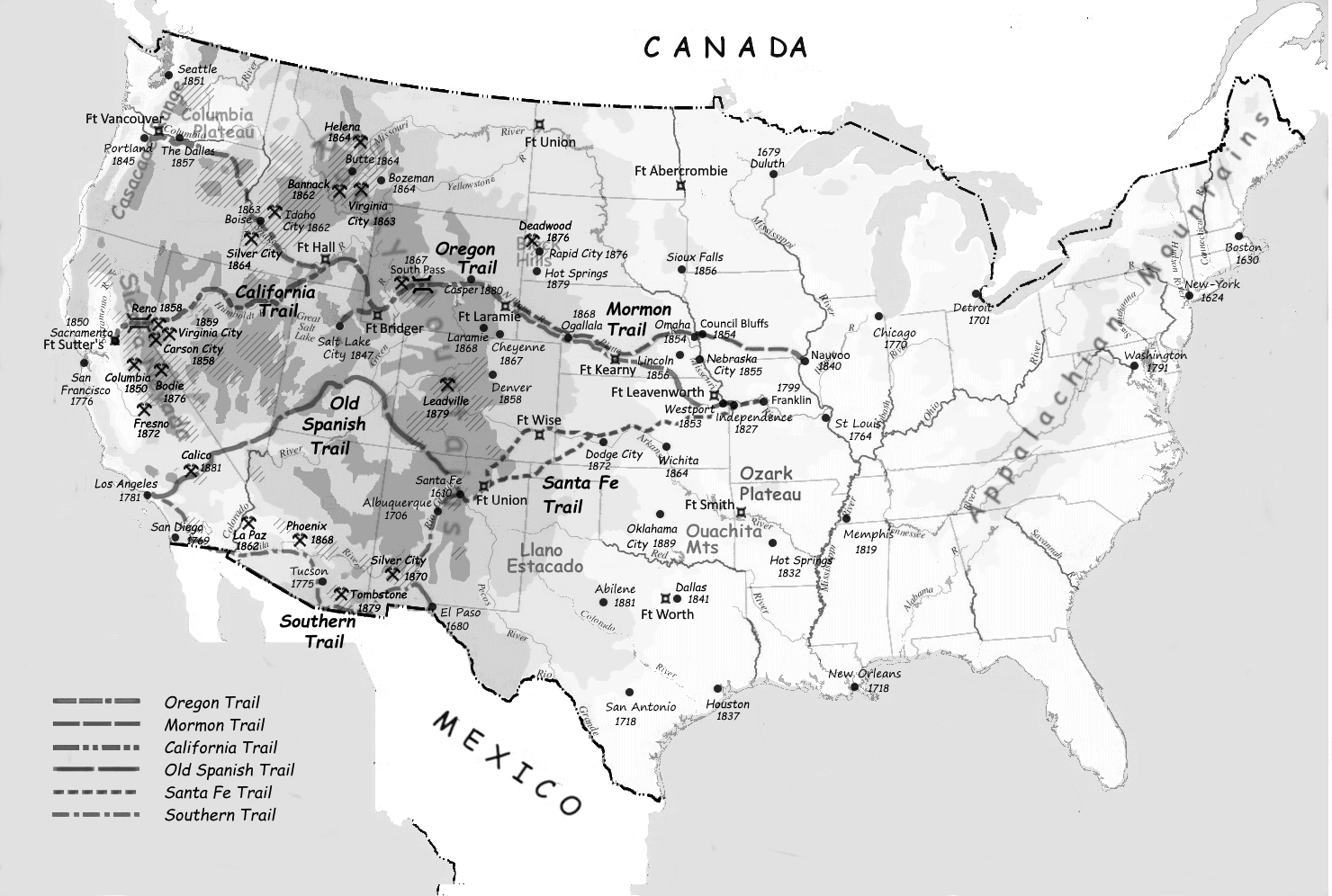
Cities developed in a haphazard fashion in the West, often on the basis of opportunity. There were different types of towns: old towns, rivers towns, mining towns, ghost towns, cattle towns and railroad towns.
Some cities existed before the migration to the West. They obviously took advantage of the latter to grow and develop. San Francisco was the main port of arrival by sea, and saw the disembarkation of Asians, South Americans, Australians and Europeans, after very long ocean voyages. Its population increased from 14,000 in 1842 to 200,000 in 1852.
Rivers towns were born thanks to St. Louis entrepreneurs who transformed the fur-trading network of forts and outposts along the upper Missouri River into a system of river towns that served both as outfitting centers at the termini of the major overland trails that crossed the Plains and trading centers that connected settlers to the national market. Independence, St. Joseph, Westport in Missouri, Omaha and Council Bluffs in Nebraska were the main towns rivers where thousands of wagons gather for West.
Mining towns were often at the beginning simple camps of miners which quickly transformed into villages when a vein was discovered. They were then equipped with saloons, grocery stores and banks to deposit the gold or silver.
Cattle towns appeared later with the cattle boom in the 1860s and 1870s. Some of them became a permanent fixture in the Kansas and Missouri landscape. Others, such as Abilene, Dodge City, Wichita, Omaha, Kansas City or Ellsworth experienced an intense but short period of expansion of a few years. However, unlike the mining towns, which in many cases become ghost towns and cease to exist once the ore is exhausted, the cattle towns switch from cattle to farming and have continued to live even after the overgrazing.
Railroad towns were born with the construction of the railroads. Some of the towns grew to become important cities like Tacoma, Reno, Fresno, Cheyenne, Billings and Albuquerque.
The main elements of a town are the main street, the general marchandise store, the hotel, the saloon, the church, the school, the bank, printing, barbershop, drugstore, the jail and the court.
Banks, small and large, are present in all cities. There are also some commercial state banks whose purpose is to make loans, and which issue dollars for this purpose.
6.1.2 Towns in the Great Basin and in Montana
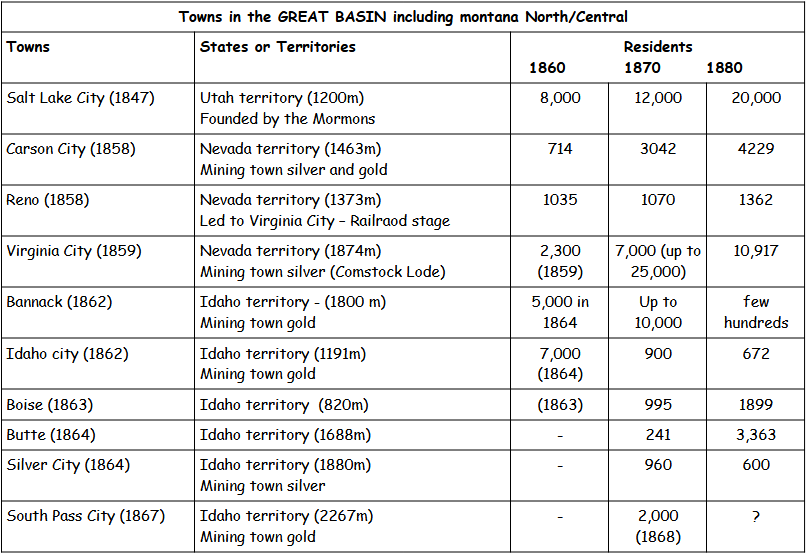
Salt Lake City (Utah territory) 1847
Salt Lake City was founded in 1847 by early pioneer settlers, led by Brigham Young, who were seeking to escape persecution they had experienced while living farther east.
Disputes with the federal government ensued over the church's practice of polygamy.
A climax occurred in 1857 when President James Buchanan declared the area in rebellion after Brigham Young refused to step down as governor, beginning the Utah War.
Virginia City (Nevada territory) 1859
In 1863, Bill Fairweather and Henry Edgar discovered gold near Alder Creek.
Virginia City quickly became a boomtown of thousands of prospectors and fortune seekers. However the remote region of the Idaho Territory was without justice system with the exception of miners' courts. Road agents as they became known were ultimately responsible for up to 100 deaths in the region in 1863 and 1864. This resulted in the formation of the Vigilance committee of Alder Gulch and the infamous Montana Vigilantes
The vigilance committee of Virginia City is described as one of the most fanatical in the West.
Bannack (Idaho territory) 1862
Bannack was the site of a major gold discovery in 1862, and served as the capital of Montana Territory briefly in 1864, until the capital was moved to Virginia City. At its peak, Bannack had a population of about ten thousand. Extremely remote, it was connected to the rest of the world only by the Montana Trail. There were three hotels, three bakeries, three blacksmith shops, two stables, two meat markets, a grocery store, a restaurant, a brewery, a billiard hall, and four saloons
....
....