



4 The Combat (extracts)
4.1The Rules
4.1.1 The round of combat
In section 3.1 we gave a general explanation of the notion of rounds and actions for situations in which PCs and NPCs act simultaneously.
Fighting is an integral part of these situations. In a fight, it's obviously vital to know what each player is going to do, and who's going to act first. Time is therefore counted in rounds, which correspond to a handful of seconds. A round allows you to perform a basic action, such as shooting, striking, jumping, diving, riding a horse, etc.
A character who, during a round, is attacked and surprised cannot act during that round.
Appendix 8 gives examples of common actions and their duration in rounds.
4.1.2 Ranged combat
In a ranged combat, a character can use a firearm, a throwing weapon (knife, tomahawk, arrow, spear) or a whip.
It is necessary to check the weapon's maximum range before attacking an adversary (see sections 3.4.1 and 3.4.2).
4.1.3 Hand-to-hand combat
In a hand-to-hand combat, a character can use a firearm (point-blank range), a bladed contact weapon (knife, tomahawk, club...) or his fists if fighting bare-handed. The good old saloon brawl is an excellent example of the latter.
...
4.2.1 The sequence of combat
The combat sequence is as follows, for each round, and for all characters involved.
-
Determining the order of combat
-
Determining the target
-
Hit the target
-
Location of the stroke
-
Damage inflicted
If a character fires several bullets in a round, he repeats the sequence from the "Target determination" phase.
4.2.2 Determining the order of combat
The combat order determines which character acts first, second etc. during the combat round.
A character using a firearm may have to fire several times in a combat round.
This will depend on his "combat speed" (including adjustments) and the combat skill he uses. An extremely fast character can fire up to 5 bullets in the same round with a revolver and 3 bullets with a rifle (see section 4.2.2.3). He can therefore act first, second or third ..... before anyone else!
A character's combat speed (see section 4.2.2.1), in conjunction with the combat skill used (see section 4.2.2.2), determines how many bullets are fired or hits made in a combat round (see section 4.2.2.3). This is then used to deduce the combat order during the combat round (see section 4.2.2.4).
4.2.2.1.Determining the skill used in a combat
4.2.2.1.1 Skill to use with revolvers
The rule is as follow:
-
If a character is ready to use his weapon AND is not surprised by his opponent(s), the "hit percentage" corresponds to the percentage of the "aimed pistol shot" skill.
-
If a character is not ready to use his weapon (unsheathed revolver, put down, etc.) OR if he is surprised by the sudden appearance of an opponent(s), he acts instinctively and the "hit percentage" corresponds to the "instinctive pistol shot" skill percentage.
Instinctive shooting is no longer POSSIBLE after round 1, unless new opponents try to surprise the character.
Fighting at a distance (> 20 m) is always aimed fire, unless otherwise specified in the scenario.
As soon as a character draws or is surprised by at least one opponent, whatever the number of opponents in front of him, he fires instinctively at ALL his opponents.
Example: you're in the main street, your character, revolver in hand, spots some opponents and decides to shoot them. Your character is perfectly aware of their presence before shooting. He's not surprised and will use the "aimed shot" skill to fire...
Example: your character is in the main street, revolver in hand. The GM tells him that he suddenly sees a gunman at the window of a house about to shoot at him. He must react quickly, as the danger is immediate. Your character will use the "instinctive pistol shot" skill.
Example: your character is in the saloon, revolver in hand, facing 1 bandit armed with a rifle pointing at the ground. The bandit suddenly raises his gun and fires at him. Your character uses "instinctive shooting". Just after firing, he spots a second man slightly behind him, about to draw his gun. Your character will use "instinctive fire" again if he decides to shoot this man.
...
4.2.2.3. Determining the number of shots or blows in the round
The following table determines the number of bullets fired and strikes made in a round, based on combat speed and the combat skill used.

If two firearms are used simultaneously by a character, the revolver held by the character's secondary hand always fires one less bullet than the revolver held by the main hand. An ambidextrous character is not affected by this rule.
...
4.2.5 Hit location
Hit localization applies only to humans or animals "resembling" humans (bears, wolves, etc.). It has a direct impact on the damage inflicted on the target, via the damage multiplier. It's much more deadly to be shot in the chest than in the foot...
4.2.5.1 With a weapon
4.2.5.1.1 Success
If the attack is successful, i.e. if the adjusted "hit percentage" roll is successful, the character rolls 1D100 to locate the hit on the "hit location" chart:

4.2.5.1.2 Critical success
If the attack is a critical success, the location of the hit is automatically adjusted, according to the difference between the success of the roll and the adjusted "hit percentage".
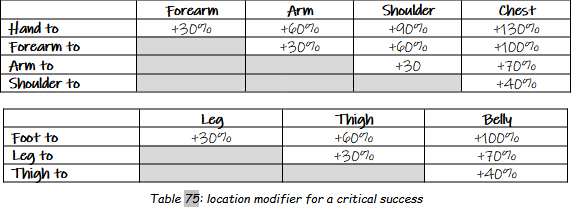
Location adjustments are always in the direction indicated, e.g. from "hand" to "forearm", never from "forearm" to "hand".
Example: Bill has 56% in the "aimed shot" skill. No adjustment is considered. He shoots at an opponent and scores 4 on the D100. This is a critical success (< 1/10th of his percentage, see section 3.3.8). The difference is (56 - 4) = 52%. If Bill hits his opponent on the hand on the location table, the hit is automatically adjusted to the forearm, because according to the table above, it requires 30% to go from hand to forearm. He would have required +60% to hit the arm.
This rule does not apply if the shooting/throwing character was aiming for a specific area (see next section).
...
4.4.3 Consequences of duels on REPUTATION
When a character wins a duel, he can increase his REPUTATION under certain conditions, described below. The change in REPUTATION is immediate.
-
If the duel was one-on-one, the winning character gains:
-
1 point of REPUTATION if his opponent has a REPUTATION greater than 5
-
2 points of REPUTATION if his opponent has a REPUTATION greater than 10
-
3 points of REPUTATION if the opponent's REPUTATION exceeds 15.
-
-
If the duel was not one-on-one, the winning characters earn :
-
1 point REPUTATION point if they were outnumbered,
-
1 point REPUTATION point if they were more numerous than their opponents, only if there were at least 2 opponents AND if the numerical superiority was at most +1.
-
Example: Bill and 4 of his friends duel 2 cowboys. They slaughter them without mercy. Bill doesn't win any REPUTATION points because he and his friends were outnumbered by +3 (5 people in Bill's camp and 2 in the cowboys' camp).
A witness must be present at the duel to gain REPUTATION.
...
4.5.2 Stunning an opponent
It is possible to attempt to stun an opponent without engaging in combat.
To do so, you must first have succeeded in approaching him discreetly from behind, using the "stealth" skill (see section 4.5.1. ).
You need to have a heavy enough object to be able to stun someone (revolver butt, stick, etc.).
Example (see table 71 above): Bill tries to approach a guard in a courtyard from behind, to knock him out. It's dark (-3) but all is silent (+2), there's little cover to move forward (0). The distance between Bill and the guard is 15m (+3). Bill must pass (-3+2+0+3) 2 stealth rolls to get right behind the guard and try to stun him.
To stun your opponent, you need to make a 1D20 roll under ((stunner's STRENGTH + 10 ) - (stunned person's RESISTANCE)).
Whether the roll is successful or unsuccessful, the victim systematically loses 1D6 HP.
If the roll is successful, the victim falls unconscious for 3D10 rounds.
Note: if the opponent is unable to defend himself (e.g. a bound prisoner), he is automatically stunned.