


2 The Character (extracts)
...
2.3.1 Roles of characteristics
WILD WEST 1873 uses 19 characteristics to describe a character.
Each characteristic allows basic actions to be performed, for example STRENGTH allows a door to be broken down, ABILITY allows an object to be recovered in flight, etc...
These 19 characteristics are: APPEARANCE, STRENGTH, SIZE, INTELLIGENCE, EDUCATION, ABILITY, RESISTANCE, CONSTITUTION, COURAGE, SPEED, EXPERIENCE, HONOR, MORALITY, LUCK, COLD BLOOD, REPUTATION, SIZE, SMELL, SEEING and HEARING.
Characteristics are expressed by a number between 0 and 24.
The higher the number, the better the characteristic.
A characteristic can never exceed 24 (except for EXPERIENCE), except temporarily, if specified in the scenario.
A characteristic can never be less than 0.
You'll find them on the front of the character sheet, with their descriptions in Appendix 2.
Refer to section 3.2 of the ADVENTURE chapter to understand how to use them.
2.3.2 Determination of characteristics
Characteristics are drawn by subtracting 3 from the result of the 4D6 roll.
The exception to this rule is EXPERIENCE, for which 3 is added to the result of the 3D6 roll.
The number of throws for each characteristic is given in the table below. Where "2 throws" are indicated, the winning result is the best of the 2 throws, except for SIZE, SMELL, SIGHT and HEARING, for which the average of the 2 throws is calculated, rounded up.

Example: defining the character's STRENGTH.
You roll 4D6-3: you get "3, 2, 1 and 6" (total = 12), subtract 3 from this total which makes 9. As the STRENGTH characteristic allows 2 rolls, you roll 4D6-3 again and this time get "5, 4, 2 and 5" (total = 16), subtract 3 from this total which makes 13. You take the best score of the 2 draws (that is 13). Your character therefore has a STRENGTH of 13, which is pretty good.
A character has a 05% chance of being ambidextrous and suffering no malus related to his "secondary hand" (see section 4.2.4.7). Roll 1D100, if the result is less than or equal to 05, your character is ambidextrous.
....
2.4.2.2.Skill categories and adjustments
Skills are divided into four categories:
-
KNOWLEDGE
-
DAILY LIFE
-
ADVENTURE
-
FIGHTING
Each category is assigned a percentage based on certain characteristics defined in section 2.3.
KNOWLEDGE = (8*EDUCATION) + (2*INTELLIGENCE)
DAILY LIFE = (3*EDUCATION) + (2*EXPÉRIENCE)
AVENTURE = 13*(EXPERIENCE + INTELLIGENCE)
COMBAT = (5*EXPERIENCE) + (3*DEXTERITY)
Example: Edward Lawrence has 6 in EDUCATION, 14 in INTELLIGENCE , 15 in EXPERIENCE and 12 in ABILITY. His percentages by category are as follows:
KNOWLEDGE = (8*EDUCATION) + (2*INTELLIGENCE) = 48+28 = 76 %
DAILY LIFE = (3*EDUCATION) + (2*EXPERIENCE) = 18 + 30 = 48 %
ADVENTURE = 13*(EXPERIENCE+INTELLIGENCE) = 13*(15+14) = 377 %
COMBAT = (5*EXPERIENCE) + (3*HABILITY) = 5*15 + 3*12 = 101 %
The percentage of each category may be adjusted according to:
-
relations with the law, the army and the Indians (section 2.7)
-
old trades (section 2.8)
The player distributes the percentage of each category among the various skills in the category, as he sees fit. He must respect the maximum skill percentages as defined in section 2.4.5.
The category percentages the player allocates are, of course, in addition to the basic or adjusted skill percentages.
It is NOT possible to allocate percentages from one category to skills in another.
The rule for allocating percentages of each category to skills is as follows: you must spend 1% in a category to gain 1% in a skill.
Note: we never recalculate the percentages of the 4 categories, even if one of the characteristics on which these percentages depend changes
...
2.7.2 Wanted by the law
When a character is wanted by the law, you need to determine which category of outlaw he falls into, and in which states/territories he is wanted.
To do this, roll 1D100 for each of the two tables below:
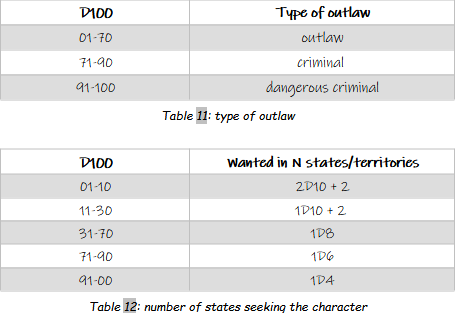
The states and territories in which the character is wanted are drawn randomly from the "States and Territories" table in Appendix 4 (eastern states) or Appendix 5 (western states).
Roll a D4 to determine which annex is used. If you roll 1, use Appendix 4; if you roll 2, 3 or 4, use Appendix 5. Then roll 1D100 to determine the state or territory in which the character is wanted. Reroll the D100 if a state or territory has already been drawn.
Outlaw
The character is wanted alive and the reward for his capture is lD10 x $50. The character is also hunted by 1D2 bounty hunter(s), and there is a 05% chance per scenario that they will try to arrest him.
Criminal
The character is wanted dead or alive and the reward for his capture is 2D4x $100. The character is also hunted by 1+1D3 bounty hunters, and there is a 10% chance per scenario that they will try to arrest or shoot him.
Dangerous criminal
The character is wanted dead or alive and the reward is 2D4 x $500. The character is also hunted by 2+2d4 bounty hunters and there is a 15% chance per scenario that they will try to arrest or shoot him.
The GM secretly rolls for the Bounty Hunter(s) before the adventure begins, and adjusts his scenario accordingly if necessary. It is not advisable to introduce the bounty hunter(s) too early in the scenario, as this could shorten it ...
Once a wanted character has definitively got rid of the bounty hunters initially on his trail, there is only a 1% chance of a new bounty hunter taking over each adventure. It's up to the GM to keep this type of account.
Skill and characteristic bonuses depend on the type of outlaw your character is:
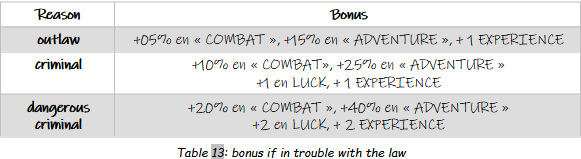
After defining whether your character is a dangerous criminal, a criminal or an outlaw :
-
roll 1D6 to determine the number of reasons for which he is wanted.
-
then roll 1D100, using the table below, to find out each motive. When a motive offers several possibilities (e.g. bank, stagecoach or train robbery), roll again between the 2 possibilities to find out the exact motive.
A character can be wanted several times for the same reason.
A dangerous criminal and a criminal are always wanted for murder. Add this motive, if it is not already present, to the list of reasons you have determined.
A simple outlaw is never wanted for murder. Reroll the 1D100 if you find this reason.
A simple outlaw is never wanted for horse theft. Consider him to have stolen cattle.
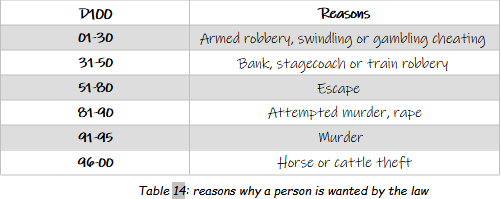
Note: if you draw the "Escape" reason, roll 1D100 on the table to find out the reason for imprisonment, repeating the roll if you come across line 51-80 again, which would mean that the character is a repeat escapee...
Refer to section 3.7 to find out about the risks of being recognized.
...
2.8.3 Former Bounty Hunter
A character may have been a bounty hunter in the past if he has MORALITY less than or equal to 7, EXPERIENCE greater than or equal to 15 and at least 9 in COURAGE.
To have been a bounty hunter, the player must pass, with 1D20, a roll above his MORALITY, a roll below his EXPERIENCE and a roll below his COURAGE.
A former bounty hunter determines his score in the "memorize a face" skill by a roll of 1D100, with a minimum of 30% (any roll below 30 does not count and must be rerolled). This skill does not increase. For obvious reasons of discretion vis-à-vis other players, a former bounty hunter will indicate 30% for the skill "memorize a face" (the classic base) on the front of his character sheet and write the true value on the back...
A bounty hunter is generally disliked by the general population, and often disliked by law enforcement officials. If recognized as such in a scenario, the character suffers a -30% malus with the law, but is not likely to be wanted. This malus is temporary during the adventure, and ceases at the GM's discretion.
A former bounty hunter has a 05% chance per adventure of meeting 1D3 men who know him and don't necessarily mean him any good. The GM secretly makes this roll before the adventure begins, and adjusts the scenario accordingly if necessary. It is not advisable to introduce this man(s) too early in the scenario, as this could shorten it...
A bounty hunter has the following bonuses and equipment:

Special: a former bounty hunter subtracts 1D6 from his HONOR and adds them to his LUCK.