


3 The Adventure (extracts)
3.1 Notions of rounds and actions
In the course of a scenario, the characters perform actions that rarely require any attention to time, or the precise telling of what is being undertaken. And fortunately, a role-playing game is above all a game of atmosphere.
However, there are sometimes situations in which player characters interact with non-player characters (NPCs), or with other player characters, and which require you to know precisely who is doing what, and how long it will take each of them to undertake the action they wish to perform. This is the case, for example, with a good old-fashioned brawl in a saloon, a shootout, an ambush ...
In such situations, it's necessary to take an interest in the passage of time and to segment it. Time is counted in rounds. A round corresponds to "a few" seconds, and enables characters to perform simple actions such as making a short move, drawing a weapon, mounting a horse, firing one or more shots, opening a door, light a wick, etc...
More complex actions may require several rounds. Climbing a wall, for example, may take more than one round if the wall is high enough, and may even require a roll under the "climbing" skill. In such cases, the GM decides how many rounds are needed for each action undertaken by the players, and whether a roll under a skill or a characteristic is required to achieve it.
Finally, some actions take much longer. These include diging a hole, searching a room, following a trail etc...
To simulate such situations, each player tells the GM what his or her character is doing, while the GM decides what the NPCs, if any, are doing. We then manage the rounds as we go along. What happens in round 1? round 2? round 3 etc.?
Example: Bill, a bounty hunter, arrives at a saloon and comes face to face with Pat, a criminal he's after! We'll need here to be precise, because we're not drinking a beer with friends ... So we have to count the time in rounds. 1st round: Bill tries to draw his pistol, but Pat, 110kg for 2m, is faster and first manages to push him over! Round 2: Bill crashes to the ground, Pat runs to his horse. Round 3: Bill gets up, Pat gets on his horse. Round 4: Bill passes through the saloon door, gun in hand, but Pat is already riding off at triple gallop on his horse ....
This example, whose sole purpose is to illustrate the need for rounds, will be taken up in detail in section 6.4, which provides examples of game situations.
As a general rule, the GM should always keep things simple when calculating the number of rounds required to perform an action, distance, difficulty, etc. .... WILD WEST 1873 must remain an atmospheric game. It should never be a complicated game.
See Appendix 8 for examples of durations for the most common actions.
....
3.2.1 Attempting an action linked to a characteristic
A character uses a characteristic to attempt an action that is clearly related to it and therefore does not require the use of a particular skill. For example, "knocking a door down" is clearly an action related to the characteristic STRENGTH.
When a character attempts an action linked to a characteristic, he or she must pass a roll with 1D20 under that characteristic, possibly modulated by a bonus or a malus if the difficulty of the action is not standard or if the character is injured.
Although most of the time, the difficulty level is standard (and there is therefore no dificulty bonus or malus to be applied to the roll under the characteristque), the GM should always check the difficulty level according to what the character is trying to do and the conditions. (see section 3.2.2).
The table below summarizes the results of a 1D20 roll under a characteristic and determines whether the action is successful, critically successful, unsuccessful or critically unsuccessful.

It is the players who roll the dice for the D20 rolls under the characteristics, unless an exception is mentioned in the scenario or explicitly written into the rules (e.g. recognizing a former hitman, cf. section 2.8.4 ).
Note 1: difficulty and injury bonuses/maluses (see sections 3.2.2 and 3.2.9) are added together.
Note 2: for MORALITY and HONOR characteristics, the action may sometimes be successful if the result of the D20 roll is higher (not lower) than the characteristic used. For example, if your character wants to shoot an opponent in the back, the GM will ask you to roll above your character's MORALITY. Your character will only be allowed to shoot if the result of the D20 roll is higher than his or her MORALITY.
...
3.3.1 Attempting an action linked to a skill
A character uses a skill to attempt an action that requires a particular ability e.g., the "orientation" skill to find the right path.
When a character attempts an action linked to a skill, he must pass a roll with 1D100 under the skill corresponding to the action, possibly modulated by a bonus or a malus if the difficulty of the action is not standard or if the character is injured.
Although most of the time, the difficulty level is standard (and there is therefore no dificulty bonus or malus to apply to the roll under the skill), the GM should always check the difficulty level against what the character is trying to do and the conditions. (see section 3.3.2).
The table below summarizes the results of a 1D100 roll under a skill, and determines whether the action is successful, critically successful, unsuccessful or critically unsuccessful.
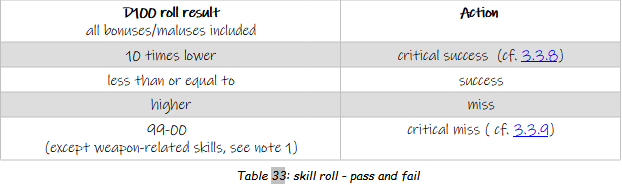
It is to the players to roll the D100, unless the scenario specifies otherwise.
In the latter case, it's to the GM to secretly roll the D100 then informs the players of what's happening, what they're seeing, etc. This may not be the reality, as the example below shows.
Example: Ted, hiding at the top of a cliff, observes the surrounding area in search of a band of Sioux Indians. The scenario states ...
Note 1: Difficulty and injury bonuses/maluses are added together.
Reminder: it is quite possible for a percentage in a skill to equal or exceed 100%. This ensures a chance of success even in the event of a malus (see section 2.4.1).
...
3.3.3 Systematically successful/unsuccessful action
Fortunately, everyday actions linked to skills don't often require a roll under 1D100 to determine whether or not they are successful. For example, if a character wants to know if there's an eagle in the sky, he'll have to roll a D100 under "observe", but if he asks if there are horses in a meadow, there's no reason to ask him to roll under "observe".
The GM must be very careful with this rule: dice rolls must be limited so as not to detract from the atmosphere of the game. WILD WEST 1873 is first and foremost a role-playing game, not a dice game.
In the same way, if a character asks the GM if he sees a sparrow 500 m away, there's no dice roll to be made. It's simply not possible.
...
3.4.1.2. Main firearms in the 1870s
The two tables below list the main firearms in circulation in the 1870s.
Appendix 12 provides more detailed information.

Note1: the Le Mat revolver does 1D8 damage; it has a second barrel below the main barrel that fires grapeshot and does 2D8 damage at 0-10m; it's a rare pistol that can't be bought.
Note2: 1D12+2 from 0-10 meters / 1D12 from 11-50 meters / 1D10 from 51-150 meters
Note3: 4D6 from 0-l0 meters / 3D6 from l1-20 meters / 2D6 from 21-30 meters
...
3.5.1 Horse class
Horses are divided into 6 classes, A, B, C, D, E and F, according to their aptitudes. A means that the horse is close to a mule, while F means that the horse is a valuable stallion.
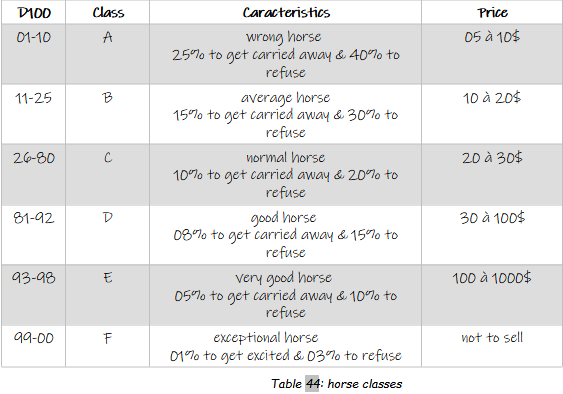
F-class horse: the F-class horse is an exceptional horse that cannot be found for sale. It should be considered as a reward during an adventure. This lightning-fast horse can also be trained to be docile and obedient. It will run when whistled at, unseat another rider on its master's command, etc. To train this type of horse, you need to pass a roll of 1D100 under the skill "knowing horses". Training can only be attempted once a month, and for a minimum of 4 hours a day.
Its price, should an owner be foolish enough to want to sell it, is over $1,000.
...
3.6.3 THE LUCK
Luck is a survival factor in WESTWARDS.
"It's better to draw an Ace than a 7" (old saloon proverb)
When a character is hit in the head, chest, heart or stomach, he rolls 1D20 under his LUCK :
-
If the result of the roll is less than or equal to his LUCK,
◦ the damage inflicted is divided by 4, rounded up.
◦ if the blow was intended to hit the heart or head, it hits the chest instead
-
If the result of the roll is a critical success
◦ the damage inflicted is divided by 8 rounded up.
◦ if the blow was intended to hit the heart or head, it hits the belly instead.
The CHANCE is a skill that can also be used if explicitly stated in a scenario. Under no circumstances can it be used otherwise.
...
3.7.2 Judgment
When a character wanted by the law and/or the army is arrested, the court that tries him or her is more or less severe, depending on a number of parameters...
It may therefore be preferable to try to get out of the situation as soon as possible, without waiting for the judgment...
A trial in a martial (military) court always takes place in a fort.
Before carrying out the 1D100 draw to determine the character's sentence (see table 57), the GM must first calculate the adjustments to this draw, using the tables for Law or Army. All adjustments are cumulative. These adjustments correspond to extenuating or aggravating circumstances selected by the Judge (tables 51 and 54) or to actions taken by the character in his defense (tables 52, 53, 55 and 56).
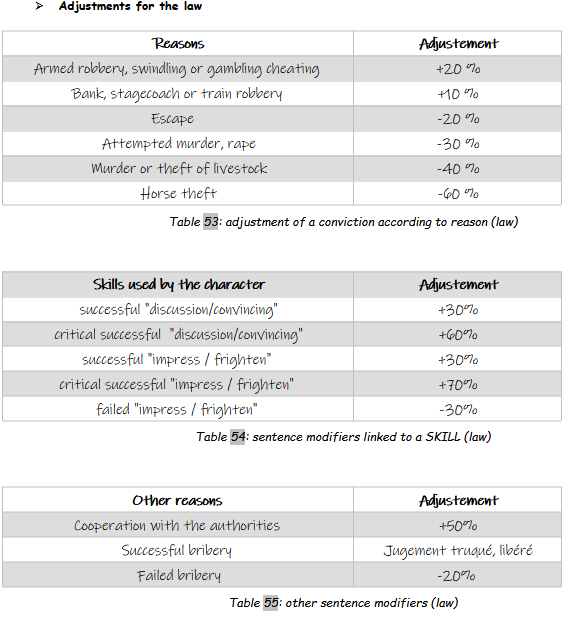
When the GM has made all the adjustments (for the law or for the army), he rolls a 1D100 to define the character's sentence:

A sentence to the noose or firing squad is effective between 1D20 days, 1 meaning dawn the next day for the Army and noon for the Law.
The "cooperation with the authorities" adjustment (which is not a skill) is at the discretion of the character and the GM. It is understood that the character must provide evidence that he knows "certain things" that could be of particular interest to the Law or the Army, or offer his services to redeem himself...
The "Corruption" adjustment (which is not a skill) is also at the discretion of the character and GM. It is understood that the character must also provide guarantees that he has a well-hidden bundle of $, for example.
The GM draws the MORALITY characteristic (and possibly the COURAGE characteristic) of the judge or court-martial as if it were that of a character.
-
For the judge (law), the GM must roll 1D20 above the judge's MORALITY before accepting anything. The minimum bribe is $100. The roll is modulated by +1 in favor of the defendant for $300 promised, +2 for $600 etc.
Note, however, that for dangerous criminals and horse thieves, the judge must also pass a COURAGE roll of 1D20 to accept the offer. -
For the court-martial (army), it's complicated to bribe, so the GM must make a roll with 1D20 above the court-martial's MORALITY with a malus of 8 (consider the court-martial as a character).
The roll is modulated by +1 in favor of the accused for $500 promised, +2 for $1000 etc...
If the character manages to bribe a judge or court-martial, he'll either be released for some amazing reason ... or offered an opportunity to escape. This opportunity is at the GM's discretion and can lead to a mini-scenario, with or without the help of old acquaintances...